
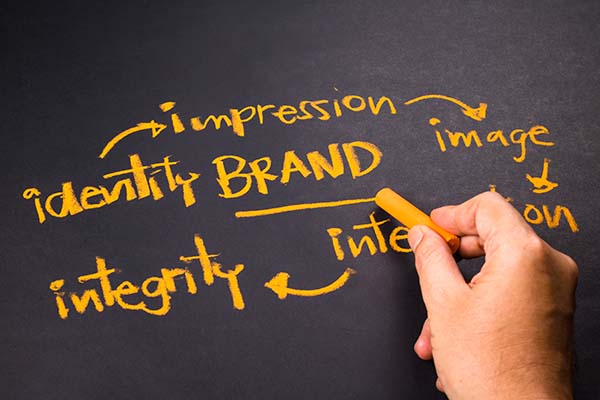
Let us start by understanding what brand identity is.
A brand’s identity is the sum of the elements through which a company presents itself and interacts with the market. These elements are found in all the channels through which the company expresses itself: visual (how the brand looks), emotional (how the brand is felt and perceived), linguistic (how the brand addresses the consumer in words), and taste and smell (when it comes to food, perfumes, cosmetics, etc.).
A company’s success is directly proportional to the impact its brand has on the market. If you want the brand you build to have a resounding impact, it is fundamental to convey accurately and very specifically the elements that set you apart from the competition and that are the very essence of the company. These elements do not always stay the same, because the company grows and matures, evolving with market trends and the dynamic behavior of consumers.
How to create a strong brand identity
To create a strong brand identity it is essential to start by “identifying what you identify with”, and here there are two main categories:
a. Identifying the company’s identity (what products/services it offers and why the company exists) – what the company was created for and on the basis of which values.
b. Identifying the company’s target buyer (who the company exists for) – the customer profile, that is, who the products/services are aimed at.
Step 1:
Identify, clarify and refine the company’s core values.
These values are distinct and unique elements that characterize the company and must be taken into account when choosing the elements that will define the brand identity. Both the linguistic and the visual elements will then be congruent and will in fact start from these values.
For example, if the company’s main value is promptness, all the elements will have to convey this value. Visual and linguistic elements will be used that suggest and convey speed of response.
How can you easily find out what your company’s values are?
By answering the questions: What is important to my company? What sets it apart from other similar companies? To answer easily you must look at the company as an entity – in fact it is a “person”, even if a legal one. Identify, then, the unique qualities of this “person”.
Step 2:
Identify the target consumer and their key characteristics.
How can you easily find out the portrait of the ideal consumer?
By answering the question: what problem do my company’s products/services solve, and who has these problems?
For example, your company makes energy drinks for a target consumer who is a young person aged 18 to 25, tired and always in a hurry between classes, who parties at night and goes to university by day. Obviously the language and visual elements used will be those of “millennials”: modern images and social-media jargon, and in no case dusty elements or rigid, outdated language.
When the elements that convey the company’s values speak the language of the ideal consumer, the brand’s impact on the target market is assured.
Step 3:
Choosing the brand identity elements
Element 1: Linguistic identity
The first important component of brand identity is the company’s linguistic identity. It is the way the company communicates with the market in words, both in writing and in speech. The words and the tone chosen are obviously essential here, as is the context in which they are integrated and used.
For example, for a company selling household appliances, the language used must be simple, everyday language, always suited to the final buyer. To put it in context, if the product is aimed at career-focused women with no time to cook, language suited to that category will be used. If, on the other hand, the product is aimed at a woman who runs the household, the language must be contextualized so that it is easy for her to understand.
Element 2: Visual identity
The second important component is visual identity, which covers all the graphic and visual elements used in the company’s physical and electronic materials: logo, fonts, styles and colors, images and graphic symbols. Because images convey information and emotion much faster than words, visual identity elements are indispensable for instantly generating an emotion in the potential consumer. That emotion anchors the brand firmly in the consumer’s memory, leaving a strong impression. Every visual element conveys something, and there is a strong link between color, shape, size and the message conveyed. For example, red is a color full of energy that invites action. It can be used successfully in a promotional campaign but would be a total failure if used to depict a bedroom visually when the idea to convey is rest and relaxation.
How to take your brand to the next level
Even if you already have an image built for the company and you are happy with it, you can always do a full assessment of the brand’s current identity. To do so, gather all the company’s written materials (presentations, brochures, catalogs, etc.) and see whether they all convey the same message and are correctly contextualized for the target consumer.
Very many companies neglect the linguistic aspect and have errors on their website or in their presentation materials, without realizing what impact this has on the market and on how the brand is perceived.
Language plays an essential role in how your audience perceives your brand. It must be consistent across all communication channels, because inconsistency can generate distrust in the target audience and be interpreted as a lack of personality and character in the brand.
Check and make sure you use the same language and tone in all of the company’s written (print and electronic), audio and video materials.